

This section is not written to create fear. It is written to restore proportion and increase understanding.
Human life exists within systems much larger than any one person, household, community, business, or country. The atmosphere, oceans, waterways, soil, climate, weather, plants, animals, and ecosystems existed long before modern society and will continue to change through natural processes as well as human influence.
Earth itself exists within an even larger system. Sunlight, the moon, gravity, seasons, Earth’s rotation and orbit, solar activity, meteors, and the wider movements of our solar system are part of the conditions within which life developed. Beyond our solar system are stars, galaxies, and a universe whose full scale and complexity we are still learning to understand.
People do not control all of these systems. However, human activities can strongly affect air, water, soil, habitats, climate, biodiversity, and the conditions within which people and other living beings must live. Understanding both realities helps restore proportion. We are neither powerless nor in control of everything.
Awareness Without Constant Alarm
Learning about pollution, climate change, habitat loss, resource use, environmental hazards, or uncertain new technologies does not mean we must remain focused on danger.
Useful awareness helps us:
-
Recognize conditions that may affect daily life.
-
Prepare for realistic local concerns.
-
Make more informed choices where possible.
-
Protect workers, families, animals, and ecosystems.
-
Understand when businesses, governments, and other institutions must act.
-
Participate more effectively in community decisions.
Information should help people respond thoughtfully. It should not create the belief that danger is everywhere, that every environmental change is a crisis, or that one person must solve problems created by entire systems. It is possible to understand serious conditions while continuing to experience beauty, enjoyment, curiosity, connection, and gratitude for the living world.
Responsibility Exists at Different Scales
Environmental responsibility is often placed heavily on individuals. People are encouraged to recycle, conserve water, use less energy, buy different products, or change how they travel. These actions may be useful, but individual choices are only one part of environmental responsibility.
Personal & Household Responsibility
Individuals and households can make choices involving indoor air, water, energy, food, chemicals, waste, transportation, soil, plants, wildlife, and emergency preparation. The practical options available to each person depend on income, health, housing, location, transportation, time, physical ability, and access to services. A renter in an apartment, a family in a city, and a person living on rural land will have different choices and limitations. Responsibility should reflect what is realistically possible.
Workplace & Organizational Responsibility
Employers, schools, health facilities, farms, nonprofits, and other organizations have responsibilities that individuals cannot fulfill alone. These may include:
-
Providing safe indoor and outdoor air.
-
Protecting workers from heat, smoke, dust, chemicals, noise, and other hazards.
-
Maintaining ventilation, filtration, water systems, buildings, and equipment.
-
Reducing pollution and waste at the source.
-
Providing training, protective equipment, rest, water, and emergency plans.
-
Including workers in decisions about monitoring and new technology.
-
Protecting privacy when sensors, cameras, or wearable devices are used.
A worker should not be expected to personally compensate for unsafe conditions created by an employer or industry.
Community Responsibility
Communities influence public trees, parks, roads, waterways, drainage, development, transportation, emergency services, land use, wildlife corridors, and access to clean-air or cooling spaces. Community planning can also help ensure that people who are older, disabled, isolated, unhoused, medically vulnerable, or without reliable transportation are included in emergency preparation. Strong communities share useful information, maintain local resources, listen to residents, and recognize that environmental conditions can differ significantly between neighborhoods.
Business & Industry Responsibility
Businesses and industries may use large amounts of energy, water, land, materials, and transportation. Their decisions can affect workers, nearby residents, wildlife, waterways, air quality, and communities far beyond the immediate facility. Their responsibilities may include:
-
Preventing pollution rather than relying only on cleanup.
-
Protecting workers and surrounding communities.
-
Using resources responsibly.
-
Maintaining equipment and pollution controls.
-
Producing durable and repairable products where possible.
-
Reporting environmental conditions honestly.
-
Safely managing waste.
-
Paying for damage and cleanup connected with their operations.
Individual households cannot correct pollution created at an industrial scale.
Government & Institutional Responsibility
Governments and public institutions establish standards, enforce protections, maintain infrastructure, support research, monitor environmental conditions, protect public lands and wildlife, and coordinate emergency response. They are also responsible for making information accessible and ensuring that environmental burdens are not repeatedly placed on communities with the least political or economic power. Public responsibility includes long-term planning. Water systems, electrical grids, roads, housing, drainage, emergency services, parks, forests, and conservation programs must be maintained before failures become crises.
Begin With the Place Where You Live
Earth systems are global, but they are experienced locally. A useful place to begin is by learning about the conditions surrounding your home, school, workplace, or community.
Consider:
-
What are the normal temperatures, rainfall patterns, winds, and seasons?
-
Where does household or community water come from?
-
How does rainwater move across the property or neighborhood?
-
What affects local air quality?
-
Which plants and animals naturally live in the area?
-
What types of soil are present?
-
Are wildfire, smoke, flooding, drought, storms, heat, cold, or dust realistic concerns?
-
Where can reliable local information be found?
-
Which organizations care for nearby parks, waterways, wildlife, or public lands?
Observation helps separate realistic local needs from distant or generalized fears. It also helps people notice seasonal changes, wildlife activity, drainage problems, unhealthy vegetation, smoke, unusual dust, or other conditions that may deserve attention.
Practical Care at Home
Environmental care does not require a perfect home, expensive technology, or a large property. Depending on housing, location, and available resources, practical actions may include:
-
Maintaining ventilation and replacing air filters when needed.
-
Reducing unnecessary indoor smoke, fragrances, pesticides, and harsh chemicals.
-
Repairing leaks and moisture problems.
-
Conserving water without neglecting health, hygiene, animals, or essential plants.
-
Keeping chemicals, oils, medicines, and waste out of drains, soil, and waterways.
-
Choosing native, climate-appropriate, or well-adapted plants.
-
Protecting soil with appropriate vegetation, mulch, ground cover, or erosion controls.
-
Creating shade while considering water availability, building safety, and local fire conditions.
-
Composting suitable materials when practical and safe.
-
Reducing unnecessary outdoor lighting and noise.
-
Using wildlife-safe fencing, screening, netting, and pest controls.
-
Maintaining defensible space or drainage where local conditions require it.
People living in apartments or shared housing can also participate. A balcony container garden, safe disposal of chemicals, attention to indoor air, reduced waste, support for local parks, and participation in building decisions are all meaningful. The most appropriate choices depend upon place. A practice that benefits a wet coastal area may be unsuitable in a dry desert, fire-prone woodland, floodplain, dense city, or cold mountain environment.
Caring for Wildlife & Ecological Relationships
Wildlife is not separate from Earth systems. Birds, insects, mammals, reptiles, amphibians, fish, plants, fungi, and microorganisms participate in pollination, seed movement, decomposition, soil formation, food webs, population balance, and many other living processes.
Practical care may include:
-
Protecting nesting, feeding, shelter, and migration areas.
-
Preserving mature trees and native vegetation when safely possible.
-
Providing appropriate habitat without making wild animals dependent on human food.
-
Reducing pesticides, herbicides, and poisons that can move through food webs.
-
Avoiding rodenticides that can poison owls, hawks, foxes, bobcats, coyotes, pets, and other predators.
-
Keeping pets from hunting or disturbing wildlife.
-
Using fencing and netting that animals can see and avoid.
-
Reducing unnecessary outdoor lighting during migration and nesting periods.
-
Protecting water sources without creating drowning, disease, or mosquito hazards.
-
Seeking qualified assistance when an animal is injured or a serious conflict develops.
Coexistence does not mean ignoring genuine risks. Venomous animals, aggressive wildlife, disease, property damage, or threats to pets and livestock may require action. The goal is to respond in proportion to the actual concern while avoiding unnecessary harm.
Preparation Is Not Fear
Preparing for environmental conditions does not mean expecting disaster. Preparation reduces uncertainty and makes it easier to respond calmly when conditions change.
Local preparation may include:
-
Knowing where to find weather, air-quality, fire, flood, and emergency information.
-
Maintaining household and community contact plans.
-
Knowing evacuation routes and possible alternatives.
-
Preparing for power outages.
-
Maintaining a cleaner-air room or suitable filtration where smoke is a concern.
-
Protecting medications, drinking water, documents, communication devices, and necessary equipment.
-
Including pets and other animals in emergency plans.
-
Understanding how to safely turn off utilities if instructed.
-
Checking on neighbors who may need assistance.
-
Keeping vehicles reasonably fueled or charged when serious conditions are expected.
Preparation should match realistic local concerns. It does not require living in a constant emergency state. Once reasonable plans and supplies are in place, people can return their attention to ordinary life knowing that they are better prepared.
Supporting Workers
Many people interact directly with Earth systems through their work. Farmworkers, construction crews, firefighters, forestry workers, fishers, miners, waste workers, utility crews, drivers, emergency personnel, restoration workers, scientists, and outdoor maintenance workers may experience heat, smoke, dust, chemicals, storms, unstable ground, polluted water, or dangerous equipment. Environmental care must include worker care.
Workers need:
-
Honest information about environmental hazards.
-
Appropriate training and protective equipment.
-
Clean drinking water, sanitation, rest, and shade.
-
Safe staffing and reasonable workloads.
-
Protection from retaliation when reporting unsafe conditions.
-
Access to exposure information collected about them.
-
A meaningful role in decisions involving monitoring, automation, or new technology.
Sensors and wearable devices may help identify danger, but they should not be used to place responsibility on the worker while unsafe conditions remain unchanged.
Participating Within the Community
Environmental responsibility becomes more effective when people work together.
Participation may include:
-
Supporting local parks, trees, wetlands, waterways, and wildlife habitats.
-
Joining restoration, planting, cleanup, or community-monitoring projects.
-
Sharing accurate information during smoke, heat, storms, flooding, wildfire, or other hazards.
-
Supporting accessible cooling spaces, clean-air spaces, shelters, and evacuation resources.
-
Attending public meetings when development may affect air, water, traffic, noise, habitat, or community safety.
-
Reporting pollution, illegal dumping, injured wildlife, damaged utilities, or unsafe public conditions.
-
Supporting local farmers, repair businesses, conservation groups, libraries, schools, and organizations that strengthen community resilience.
No one must participate in every issue. Choosing one local concern that feels meaningful and manageable can be enough.
Using New Technology With Perspective
Satellites, sensors, artificial intelligence, environmental apps, digital models, drones, robots, and advanced materials may help people understand environmental conditions and respond earlier. These tools can be valuable, but they are not perfect authorities. Before relying upon an emerging system, useful questions include:
-
Has it been independently tested?
-
Is the information accurate enough for the intended decision?
-
Who collects and owns the data?
-
Can workers and residents see or correct the information?
-
Can the system be maintained and repaired?
-
What happens during a power, internet, software, or equipment failure?
-
Does it address the source of a problem or merely continue measuring it?
-
Does it create new waste, energy use, surveillance, or ecological disturbance?
-
Would a simpler and more accessible approach work?
Technology should support scientific knowledge, community experience, worker observations, and Indigenous and place-based knowledge. It should not automatically replace them.
Participation Without Perfection
No individual or household can remove every pollutant, restore every habitat, redesign infrastructure, determine industrial policy, or correct every effect of climate change. People should not be made to believe that purchasing the right products or following a perfect lifestyle will solve problems created across entire industries, economies, and generations. At the same time, individual and local choices are not meaningless. They can protect a household, reduce avoidable harm, support wildlife, conserve resources, strengthen community connections, influence institutions, and help establish healthier patterns. The goal is participation—not perfection. Responsibility should remain connected to power, resources, and scale. A household, a small business, a multinational company, and a national government do not have the same influence or responsibilities.
A Simple Place to Begin
A manageable beginning might include:
-
Learn about the environmental conditions where you live.
-
Make one practical improvement at home.
-
Prepare for one realistic local concern.
-
Reduce one source of unnecessary waste, pollution, or wildlife harm.
-
Support one community, conservation, or restoration effort.
-
Encourage businesses and public institutions to fulfill their responsibilities.
These steps do not have to happen at once. Understanding develops over time, and appropriate actions may change with age, health, resources, location, and circumstances.
Living Within Shared Systems
Earth systems are larger than any one person, household, business, community, or country. We do not control them, and no individual is responsible for repairing everything that has been damaged. We can understand the conditions around us, prepare without living in fear, care for the places and living beings within our reach, and support responsible action at every level. Small choices do not replace larger change, but they remain part of how larger change becomes possible. Responsibility without alarm means remaining aware, keeping life in proportion, and participating where we genuinely can.
Kindergarten–Grade 3
Caring for Earth Without Worry
Listen to This Page
The written text on this page serves as the full and official version of this content

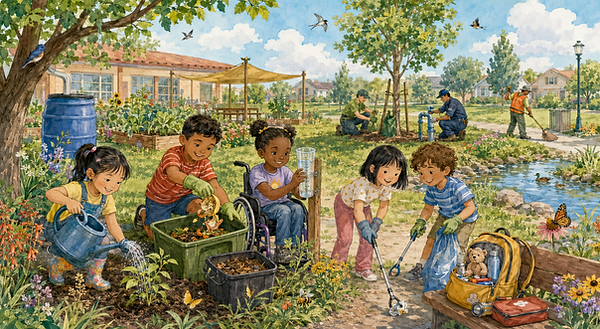
Earth is much bigger than any one person. Its air, oceans, rivers, soil, weather, plants, and animals have been changing for a very long time.
People cannot control everything that happens on Earth. But our choices can affect air, water, soil, climate, and living things. We are not responsible for fixing everything by ourselves. We can simply care for the places and living things around us.
Learn About Your Place
Every place is different. A desert is not the same as a forest, city, beach, or mountain.
You can learn about:
-
the weather and seasons
-
where your water comes from
-
the plants and animals that live nearby
-
how rain moves across the ground
-
whether your area sometimes has heat, smoke, storms, floods, or fire
Knowing your area helps you understand what is normal and what your community may need to prepare for.
Small Ways to Help
At home or school, you might:
-
turn off unused lights
-
use water carefully
-
keep trash and chemicals out of soil and water
-
grow plants suited to the local climate
-
protect helpful insects and wildlife
-
reuse, repair, recycle, or compost when possible
-
keep outdoor spaces clean
-
tell an adult about a water leak or unsafe condition
You can help whether you live in a house, apartment, city, or rural area. A small garden pot, a clean neighborhood, or caring for a park all have value.
Caring for Wildlife
Animals need safe places to find natural food, water, and shelter. Birds, bees, butterflies, bats, and many other animals help pollinate flowers, spread seeds, and keep ecosystems working.
We can help by:
-
watching wildlife from a respectful distance
-
protecting nests and habitats
-
keeping pets from chasing wild animals
-
using animal-safe fences and netting
-
avoiding poisons that can harm wildlife
-
asking a knowledgeable adult for help when an animal is hurt
Caring for wildlife also means staying safe around animals that can bite, sting, or carry disease.
Working Together
Some environmental jobs are too large for one person. Schools, businesses, farms, communities, and governments must also care for people and Earth.
They can:
-
keep air and water clean
-
protect workers
-
care for parks and waterways
-
maintain roads, pipes, and power systems
-
reduce pollution and waste
-
prepare safe places for emergencies
Being Prepared Helps Us Feel Ready
Preparing does not mean expecting something frightening. It means knowing what to do if the weather changes or the power goes out.
Families can know where to find information, keep useful supplies, include pets in plans, and decide how to contact one another.
Once a plan is ready, we can return to playing, learning, and enjoying ordinary life.
Key Idea
You do not have to solve every problem on Earth. Learn about your own area, help where you can, work with others, and continue enjoying the beauty and wonder of the living world.
Grades 4–7
Understanding Earth Without Constant Alarm

Listen to This Page
The written text on this page serves as the full and official version of this content
Earth is part of systems much larger than any individual, community, or country. The atmosphere, oceans, waterways, soil, weather, climate, plants, animals, and ecosystems developed over long periods and continue to change.
Earth also moves within a larger space system. Sunlight, gravity, the moon, seasons, Earth’s rotation and orbit, solar activity, and other natural forces influence conditions on our planet.
People cannot control all of these systems. However, human activities can strongly affect air, water, soil, habitats, climate, and biodiversity. Understanding both facts gives us a useful sense of proportion: we are not powerless, but we are also not responsible for controlling everything.
Awareness Should Be Useful
Learning about pollution, climate change, habitat loss, or environmental hazards does not mean thinking about danger all the time.
Useful information can help people:
-
understand realistic local conditions.
-
make thoughtful choices.
-
prepare for weather and emergencies.
-
protect people, workers, animals, and ecosystems.
-
take part in community decisions.
-
recognize when businesses or governments need to act.
-
We can understand serious environmental issues while still enjoying nature, friends, family, creativity, and daily life.
Responsibility Is Shared.
Environmental responsibility exists at several levels.
Individuals and Households.
People may conserve water and energy, reduce waste, protect indoor air, avoid harmful chemicals, care for soil and plants, and prepare for local emergencies.
What is possible depends on housing, income, health, location, time, transportation, and physical ability. Someone living in a city apartment has different options from someone living on a farm or rural property. Responsible choices should be practical for the person and place.
Schools and Workplaces.
Schools, farms, hospitals, businesses, and other organizations are responsible for safe air, water, buildings, equipment, and working conditions. They should protect people from heat, smoke, dust, chemicals, noise, and other hazards.
Workers should receive training, drinking water, rest, protective equipment, and honest information. Individuals should not be expected to correct unsafe conditions created by an employer or industry.
Communities.
Communities make decisions about parks, roads, public trees, drainage, transportation, wildlife corridors, land use, and emergency services.
Good planning includes people who may need additional support, including older adults, disabled people, medically vulnerable residents, people without housing, and those without dependable transportation.
Businesses and Industries.
Large operations may use much more water, energy, land, and materials than individual households. They are responsible for preventing pollution, protecting workers and nearby communities, maintaining equipment, managing waste safely, and helping repair damage connected with their activities.
Governments and Public Institutions.
Governments create and enforce protections, maintain infrastructure, monitor environmental conditions, support research, protect public lands, and coordinate emergencies. They also have a responsibility to make information accessible and avoid placing environmental burdens repeatedly on communities with the fewest resources.
Begin Where You Live.
Global Earth systems are experienced locally. Begin by learning about your own surroundings:
-
What are the usual temperatures, winds, rainfall, and seasons?
-
Where does your water come from?
-
Where does rainwater flow?
-
What affects local air quality?
-
Which plants and animals naturally live there?
-
What kind of soil is present?
-
Are heat, wildfire, smoke, flooding, drought, storms, cold, or dust realistic concerns?
-
Where can reliable local information be found?
Observation helps separate realistic needs from distant worries. It also helps people notice changing seasons, wildlife activity, drainage problems, unhealthy plants, smoke, or unusual dust.
Practical Care in Different Places.
Environmental care does not require an expensive system or a large property.
Depending on the location, people may:
-
replace air filters and support good ventilation.
-
repair leaks and moisture problems.
-
keep oils, medicines, and chemicals out of drains and soil.
-
use native or climate-appropriate plants.
-
protect soil with plants, mulch, or ground cover.
-
conserve water without neglecting health, animals, or essential plants.
-
compost suitable materials.
-
reduce unnecessary outdoor light and noise.
-
use wildlife-safe fencing and pest controls.
-
maintain drainage or fire-safe spaces where needed.
-
The best choices depend on place. A method that works in a wet coastal region may not be appropriate in a desert, floodplain, cold mountain area, fire-prone forest, or crowded city.
Caring for Wildlife and Natural Relationships.
Wildlife contributes to pollination, seed movement, decomposition, soil formation, food webs, and many other natural processes.
People can help by:
-
protecting nesting and migration areas.
-
preserving appropriate native plants and mature trees.
-
reducing pesticides and poisons.
-
keeping pets from hunting wildlife.
-
using fencing and netting animals can see.
-
reducing unnecessary lighting during migration.
-
protecting water without creating mosquito or drowning hazards.
-
seeking qualified help for injured animals or serious conflicts.
Coexisting with wildlife does not mean ignoring genuine risks. The goal is to respond to the actual concern while avoiding unnecessary harm.
Preparation Is a Form of Calm Planning.
Preparing for environmental conditions does not mean expecting disaster. A realistic plan can reduce confusion and help people respond more calmly.
Preparation may include:
-
knowing where to find weather, air-quality, fire, and flood information.
-
planning how household members will communicate.
-
knowing evacuation routes and alternatives.
-
preparing for power outages.
-
protecting medicine, water, documents, and communication devices.
-
including pets and other animals.
-
checking on neighbors who may need help.
-
maintaining cleaner indoor air when smoke is a local concern.
Plans should match realistic local conditions. Once reasonable preparations are complete, people can return their attention to ordinary life.
Technology and the Future.
Sensors, satellites, cameras, computer models, and artificial intelligence may help communities detect pollution, understand weather, locate leaks, monitor wildlife, and prepare for hazards.
These tools should support people not invade privacy, replace safe working conditions, or place all responsibility on individuals. Future environmental systems work best when technology, healthy ecosystems, community knowledge, and fair public planning are used together.
Young People Can Participate.
Young people can:
-
learn about their local environment.
-
join a garden, cleanup, planting, or restoration project.
-
participate in community science.
-
share accurate information.
-
report leaks, dumping, or unsafe public conditions to an adult.
-
support accessible parks and emergency resources.
-
ask how decisions affect workers, wildlife, and different neighborhoods.
-
appreciate and enjoy the natural world.
Key Idea.
Environmental responsibility is shared. Individuals can make meaningful choices, but schools, workplaces, businesses, communities, and governments also have important duties. We can stay informed and prepared without living in fear—and continue to experience curiosity, beauty, connection, and gratitude for Earth.