
Climate, Air & Ecological Conditions

Listen to This Page
The written text on this page serves as the full and official version of this content

Earth’s climate, air, water, soil, weather, plants, animals, and ecosystems are deeply interconnected. A change in one can influence many others. Temperature, rainfall, drought, wind, humidity, storms, wildfire, smoke, ocean conditions, and seasonal patterns affect water supplies, growing conditions, food systems, biodiversity, migration, human and animal health, and the stability of ecosystems. These conditions have always varied naturally. However, human-caused climate change is now altering temperatures, rainfall patterns, oceans, ice, seasons, and the frequency or intensity of some extreme events.
The effects are not limited to the climate alone. Climate change interacts with air pollution, water availability, soil health, wildfire, habitat loss, invasive species, food production, coastal conditions, and other environmental pressures. These combined changes may affect different places and populations in different ways. The separate Climate Change section explores the scientific evidence, known impacts, future projections, and practical responses in greater detail.
Air is an essential part of this living connection. It carries oxygen, carbon dioxide, moisture, pollen, seeds, microorganisms, smoke, dust, gases, particles, and pollutants across neighborhoods, ecosystems, regions, and continents. Clean air supports human health, wildlife, plants, soil, water, and the natural processes that sustain life. Polluted air can affect breathing and cardiovascular health, damage vegetation, alter soil and water, reduce visibility, disrupt wildlife, and reach communities far from where the pollution began.
Our ability to observe and understand these conditions is rapidly improving. Satellites can track weather, drought, vegetation, snow, ice, oceans, wildfire, smoke, floods, land use, greenhouse gases, and air pollution. Local air sensors can reveal pollution patterns within individual communities. Ocean floats and autonomous instruments measure temperature, salinity, oxygen, circulation, and other changing conditions.
Wildlife cameras, acoustic monitors, drones, environmental DNA, and artificial intelligence can help researchers study species, habitats, migration, and biodiversity. Advanced forecasting and early-warning systems may also give communities more time to prepare for extreme heat, drought, wildfire, flooding, severe storms, and other hazards.
Other approaches are intended to reduce environmental harm, support adaptation, and protect or restore natural systems. These include pollution controls, water reuse, precision agriculture, ecological restoration, biochar, carbon capture, direct air capture, lower-impact materials, heat-resilient buildings, and many other developing technologies.
Technology alone, however, cannot replace healthy forests, grasslands, wetlands, oceans, waterways, soils, and diverse living communities. Understanding these interconnections can help individuals, communities, businesses, governments, and researchers make more informed choices while caring for the natural systems upon which all life depends.
Traditional Approaches to Climate, Air & Ecological Conditions

Listen to This Page
The written text on this page serves as the full and official version of this content
People have always observed weather, seasons, air, water, plants, animals, and changes in the land. Indigenous peoples, farmers, fishers, herders, gardeners, and local communities developed knowledge through long experience with particular places. Seasonal planting, water conservation, controlled burning, migration routes, food preservation, shelter design, and careful use of local plants and animals helped communities respond to environmental conditions.
As towns, cities, agriculture, transportation, manufacturing, and energy systems expanded, environmental management became increasingly organized through government agencies, scientific institutions, public infrastructure, and regulations. Weather stations collected local measurements. Air-quality agencies monitored pollutants. Parks, forests, wetlands, waterways, and wildlife areas received different forms of protection. Emergency systems helped communities prepare for storms, floods, drought, wildfire, extreme temperatures, and other hazards.
Many traditional modern approaches addressed environmental concerns separately. Air pollution, water quality, soil damage, wildlife loss, public health, agriculture, land use, waste, and climate were often managed by different agencies and industries. This helped develop specialized knowledge, standards, and protections, but it sometimes overlooked how strongly these systems influence one another.
For much of the industrial era, natural resources were also treated as abundant supplies for human use. Forests were cleared, rivers redirected, wetlands drained, wildlife displaced, soils intensively cultivated, and fossil fuels extracted and burned to support homes, businesses, transportation, agriculture, and expanding economies. Pollution controls and restoration efforts were often introduced after damage had already occurred.
Traditional approaches have produced important benefits, including weather forecasting, air-quality standards, protected lands, wildlife conservation, pollution controls, public-health protections, and disaster response systems. However, they have not always addressed accumulated pollution, habitat fragmentation, biodiversity loss, environmental inequality, or the growing effects of human-caused climate change.
Today, long-established knowledge, scientific research, regulation, conservation, and local experience remain essential. The continuing challenge is to connect them more effectively recognizing that climate, air, water, soil, wildlife, food systems, human communities, and economic activity are parts of the same living Earth system.
Traditional Approaches to Climate, Air & Ecological Conditions Deeper Understanding
Listen to This Page
The written text on this page serves as the full and official version of this content
Traditional approaches to climate, air, and ecological conditions include both long-established local knowledge and the modern systems developed to monitor, manage, use, and protect the environment. They range from Indigenous land stewardship, seasonal observation, farming knowledge, forest management, and community conservation to weather stations, pollution controls, zoning, protected lands, wildlife programs, public-health regulations, and emergency response systems. These approaches have supported food production, employment, transportation, manufacturing, public safety, housing, and economic growth. They have also sometimes treated air, water, soil, forests, wildlife, and communities as separate concerns rather than interconnected parts of one living system.
Learning From Seasons, Weather & Place
Long before satellites and computer forecasting, people learned to recognize environmental patterns by observing the world around them. Communities watched:
-
Seasonal temperatures and rainfall.
-
Clouds, winds, humidity, and storms.
-
River levels, snowpack, springs, and groundwater.
-
Plant flowering, seed production, and harvest times.
-
Animal migration, breeding, feeding, and movement.
-
Soil moisture, fertility, erosion, and recovery.
-
Ocean currents, tides, fish populations, and coastal conditions.
This knowledge helped people decide when to plant, harvest, hunt, fish, move animals, conserve water, gather food, prepare shelter, conduct cultural burning, or avoid hazardous conditions. Indigenous and place-based knowledge often developed over many generations. It connected environmental observation with responsibilities to land, water, plants, animals, and future generations. Although some practices were disrupted or prohibited through colonization and land-management policies, many continue to provide valuable guidance for conservation, forestry, agriculture, fire stewardship, and ecosystem restoration. Local knowledge remains important, particularly when it is respected and used with the participation and consent of the communities that hold it.
Weather Observation & Public Safety
Traditional modern weather systems rely on ground-based weather stations, radar, balloons, ships, aircraft, river gauges, and reports from local observers. These systems measure temperature, precipitation, wind, humidity, atmospheric pressure, visibility, river levels, and other conditions. Forecasts and warnings help communities prepare for:
-
Severe storms and high winds.
-
Flooding and flash floods.
-
Drought.
-
Extreme heat and cold.
-
Wildfire and smoke.
-
Dust storms.
-
Dangerous ocean and coastal conditions.
-
Conditions affecting farms, roads, aviation, shipping, and outdoor work.
Emergency management traditionally focuses on evacuation plans, shelters, firefighting, flood control, public alerts, road closures, and restoring services after a hazardous event. These systems save lives, but their effectiveness depends on reliable communication, adequate staffing, transportation, accessible shelters, and the ability of residents to respond. Older adults, children, people with disabilities, outdoor workers, people without vehicles, rural residents, unhoused people, and households with limited income may need additional support before, during, and after an emergency.
Conventional Air-Quality Management
Modern air-quality management developed largely in response to visible smoke, industrial emissions, vehicle exhaust, smog, worker illness, and rising public-health concerns. Traditional regulatory approaches identify major pollutants, establish limits, issue permits, inspect facilities, monitor outdoor air, and require pollution-control equipment. Common sources include:
-
Power plants and factories.
-
Oil, gas, mining, and refining operations.
-
Cars, trucks, ships, trains, and aircraft.
-
Construction and road dust.
-
Agricultural equipment, livestock operations, and field burning.
-
Wildfire and prescribed fire.
-
Wood-burning stoves and fireplaces.
-
Solvents, paints, cleaning products, and industrial chemicals.
-
Waste burning and landfills.
Pollution-control systems may capture particles, filter exhaust, reduce harmful gases, improve combustion, control dust, or change how materials are stored and handled. Vehicle-emission standards and cleaner fuels have also reduced some forms of air pollution. These protections have improved air quality in many places. However, outdoor monitoring stations may be too widely spaced to reveal conditions on individual streets, near schools, beside highways, around industrial facilities, or within rural communities. Official regional averages may not reflect what a particular neighborhood or worker is breathing.
Indoor air has also received less attention than outdoor air, even though people spend much of their time inside homes, schools, workplaces, and vehicles. Smoke, mold, dust, radon, combustion gases, building materials, fragrances, pesticides, and inadequate ventilation can all influence indoor conditions.
Land, Forest & Fire Management
Traditional land-management systems include forestry, grazing, agriculture, parks, wildlife refuges, watershed protection, and public or private conservation lands. Forests have often been managed for timber production, recreation, watershed protection, wildlife habitat, and fire prevention. Common practices include logging, thinning, road construction, grazing, removing dead vegetation, fire suppression, and prescribed burning. Decades of suppressing nearly every fire altered some ecosystems that naturally depend on periodic burning. In certain forests and grasslands, accumulated vegetation can contribute to more hazardous fire conditions. At the same time, prescribed fire and mechanical thinning must be carefully planned because they can produce smoke, disturb soil, affect wildlife, introduce invasive plants, or damage habitats when used inappropriately.
Indigenous cultural burning is not simply another form of vegetation removal. It is a place-specific practice connected with ecological knowledge, food systems, community responsibilities, and the needs of particular plants and animals. Effective partnerships require respect for tribal sovereignty and the knowledge of cultural fire practitioners.
Wildlife, Habitats & Biodiversity
Traditional wildlife management has often focused on individual species, hunting and fishing limits, endangered-species protection, population counts, pest control, and designated protected areas. These programs have helped recover some species and preserve important habitats. National parks, wildlife refuges, marine protected areas, conservation easements, and local open spaces can protect breeding grounds, migration routes, forests, wetlands, coastlines, and other ecologically important places. However, protecting an isolated area may not be enough. Animals move across property lines, highways, farms, cities, waterways, and political boundaries. Roads, fencing, development, dams, artificial lighting, noise, pollution, and habitat fragmentation can interfere with migration, feeding, reproduction, and access to water.
Traditional pest-control programs have also relied heavily on poisons, traps, pesticides, or eliminating animals considered inconvenient. These methods may affect non-target animals, predators, pollinators, soil organisms, pets, and water supplies. More complete ecological management considers the role each species plays and looks for ways to reduce conflict without unnecessarily damaging the wider ecosystem.
Water, Soil & Ecological Health
Water, soil, and air are often managed by different agencies, even though pollution and ecological damage move between them. Airborne particles and chemicals can settle onto soil and water. Contaminated soil can release dust or carry pollutants into rivers during storms. Water pollution can damage wetlands, aquatic species, farms, fisheries, and drinking-water sources. Loss of vegetation can increase erosion, heat, flooding, and dust.
Traditional water and soil protections may include wastewater treatment, erosion controls, agricultural conservation programs, wetland protections, drinking-water standards, industrial permits, and cleanup requirements for contaminated sites. These systems have prevented or reduced many forms of harm. Yet cleanup frequently begins only after pollution has been discovered. Restoring contaminated soil, groundwater, rivers, wetlands, or industrial properties can take years and may cost far more than preventing the damage.
Workers & Occupational Exposure
Workers are often the first people exposed to environmental hazards and the people expected to manage them. Those at greater risk may include:
-
Farmworkers exposed to heat, dust, pesticides, smoke, and repetitive labor.
-
Miners and quarry workers exposed to dust, metals, noise, and dangerous equipment.
-
Factory and refinery workers exposed to fumes, chemicals, particles, and high temperatures.
-
Construction and demolition workers exposed to silica, asbestos, lead, dust, and contaminated materials.
-
Firefighters, forestry crews, and emergency workers exposed to smoke, heat, unstable terrain, and physical danger.
-
Waste, recycling, sewage, and cleanup workers exposed to chemicals, biological materials, sharp objects, and polluted water.
-
Transportation and warehouse workers exposed to exhaust, heat, noise, and heavy equipment.
-
Fishers, agricultural workers, and outdoor laborers affected by storms, extreme temperatures, poor air quality, and changing local conditions.
-
Scientists, rangers, restoration crews, and wildlife workers operating in remote or hazardous environments.
Protective regulations may require training, ventilation, respirators, safety equipment, exposure limits, medical monitoring, rest periods, sanitation, and emergency procedures. Their effectiveness depends on enforcement, appropriate equipment, honest reporting, and whether workers can raise concerns without losing income or employment. Temporary workers, migrant workers, independent contractors, low-wage workers, and people without secure immigration status may have fewer practical protections. Some workers also carry contaminants home on clothing, footwear, vehicles, or equipment, potentially exposing family members. Worker health should therefore be considered part of environmental health not a separate issue.
Economic Benefits, Costs & Dependence
Industries that use land, water, forests, minerals, fuels, plants, and animals provide jobs, materials, energy, food, transportation, housing, and tax revenue. Entire communities may depend on agriculture, forestry, fishing, manufacturing, mining, tourism, shipping, or energy production. Environmental regulations can require businesses and governments to invest in cleaner equipment, monitoring, safer materials, waste treatment, habitat protection, or contaminated-site cleanup. These changes may create short-term costs, particularly for small businesses, farms, rural utilities, and communities with limited budgets. However, pollution and ecological damage also carry substantial costs. These may include:
-
Worker illness and lost income.
-
Increased medical expenses.
-
Damage to crops, forests, fisheries, buildings, and infrastructure.
-
Contaminated drinking water or private wells.
-
Reduced property values.
-
Loss of recreation and tourism.
-
Expensive cleanup and restoration.
-
Disruption of culturally important lands and resources.
-
Reduced productivity and missed school or work.
-
Long-term care for polluted industrial or mining sites.
The price of a product or service does not always include these wider costs. Some costs are transferred to workers, nearby residents, taxpayers, future generations, or the natural environment.
Communities can also face difficult transitions when a major employer closes, a resource becomes depleted, or stronger environmental protections change how an industry operates. Planning may require worker retraining, income support, cleanup employment, economic diversification, infrastructure investment, and meaningful community participation.
Effects on Communities
Environmental benefits and burdens are not distributed equally. Some communities have more trees, parks, clean water, healthy housing, reliable public services, and distance from major pollution sources. Others may be located near highways, ports, landfills, industrial facilities, mines, refineries, large livestock operations, or contaminated properties. Historically, zoning, housing discrimination, political exclusion, land displacement, and unequal investment have placed greater environmental burdens on some low-income, Indigenous, rural, and racial or ethnic communities. These communities may experience several exposures at once, such as polluted air, unsafe water, excessive heat, noise, poor housing, limited health care, and few safe outdoor spaces. Community knowledge is especially important because residents often notice odors, dust, smoke, unusual illnesses, changes in wildlife, contaminated runoff, or repeated equipment failures before these patterns appear in official records. Public meetings and written notices do not always provide meaningful participation. Residents may face language barriers, transportation difficulties, inaccessible meeting times, limited internet access, technical documents, or fear that speaking out could affect employment. Effective participation requires clear information, accessible meetings, independent testing where appropriate, and genuine influence over decisions.
Regulation, Monitoring & Enforcement
Traditional environmental protections usually depend on laws, permits, inspections, environmental reviews, pollution limits, protected areas, and penalties for violations. These systems provide important safeguards, but gaps can occur when:
-
Standards cover only certain pollutants or sources.
-
Monitoring stations are too far from affected communities.
-
Agencies lack adequate staffing or funding.
-
Small or repeated releases are not fully documented.
-
Pollution crosses city, county, state, tribal, or national boundaries.
-
Several individually permitted sources create a larger combined burden.
-
Cleanup responsibility is disputed or the responsible company no longer exists.
-
Rules are not updated as knowledge and measurement improve.
Environmental management is most effective when monitoring is transparent, workers and residents can report concerns safely, enforcement is consistent, and decisions consider cumulative effects rather than examining every facility or pollutant in isolation.
What Traditional Approaches Have Contributed
Traditional and conventional systems have provided essential knowledge and protections. These include:
-
Generations of place-based environmental understanding.
-
Weather observations and public-warning systems.
-
Air- and water-quality standards.
-
Pollution-control technologies.
-
Protected parks, forests, wetlands, waterways, and wildlife habitats.
-
Workplace safety requirements.
-
Conservation programs and species recovery.
-
Environmental reviews and public participation.
-
Emergency response and disaster preparation.
-
Scientific institutions and long-term environmental records.
The central limitation is often fragmentation. Climate patterns, air, water, soil, wildlife, worker health, community health, land use, and economic activity have frequently been managed as separate subjects.
A more complete approach builds upon traditional knowledge, scientific monitoring, regulation, worker protection, and conservation while recognizing their connections. Protecting ecological conditions also means protecting the people who live within them, the workers who interact with them, and the communities whose lives and economies depend upon them
Emerging & Future Climate, Air & Ecological Conditions

Listen to This Page
The written text on this page serves as the full and official version of this content
The ways we observe, understand, protect, and restore environmental conditions are changing rapidly. Satellites, local sensors, drones, wildlife cameras, environmental DNA, acoustic monitors, ocean instruments, and advanced forecasting systems can gather information about weather, air, water, soil, forests, oceans, pollution, wildlife, and changing ecosystems. These tools may help identify problems earlier, improve public warnings, guide land and water management, protect workers, and provide communities with more detailed information about local conditions.
Artificial intelligence is becoming an important part of this work. AI can analyze enormous amounts of information from satellites, sensors, cameras, scientific records, and field observations. It may help track smoke and pollution, forecast floods or wildfire conditions, recognize wildlife through images and sounds, identify environmental damage, and compare possible conservation or restoration plans. Future AI systems may create detailed digital models of cities, watersheds, farms, forests, coastlines, or entire regions. These environmental “digital twins” could allow researchers and communities to explore how development, industry, land use, restoration, or emergency decisions might affect interconnected systems before actions are taken. AI, however, depends on the accuracy of its data and the assumptions built into it. It should support scientific, worker, Indigenous, local, and community knowledge not replace them.
Other emerging technologies are intended to prevent pollution or help repair environmental harm. These include improved industrial filters, cleaner manufacturing, advanced air and water treatment, pollution detecting materials, ecological restoration tools, biochar, carbon capture, direct air capture, heat resilient buildings, habitat mapping, wildlife crossings, and robotic systems that may plant vegetation, remove invasive plants, monitor remote areas, or assist with hazardous cleanup.
Farther into the future, researchers are exploring self-powered environmental sensors, AI coordinated monitoring networks, robotic ecosystem restoration, materials that absorb or break down pollutants, engineered plants or microorganisms that remove contamination, and buildings or infrastructure designed to filter air, manage water, reduce heat, and provide habitat.
Some proposed technologies extend even further, including large scale attempts to alter atmospheric, ocean, weather, or sunlight conditions. Biotechnology and gene editing are also being explored for protecting threatened species, controlling invasive organisms, improving pollution cleanup, or helping damaged ecosystems recover. Many of these future possibilities are experimental. They have not yet been proven safe, effective, affordable, or appropriate for large-scale use. Some could create unintended effects that cross property lines, ecosystems, communities, or national borders. Living organisms and large environmental systems are especially difficult to control once changes have been introduced.
Technology may also create new worker, economic, and community concerns. Advanced systems can be expensive and may depend on proprietary software, subscriptions, specialized equipment, reliable electricity, communication networks, replacement parts, and secure data storage. Questions remain about who owns environmental data, who benefits from these systems, which jobs may be created or displaced, and whether smaller, rural, tribal, or lower income communities will have equal access.
Emerging and future approaches may provide valuable new ways to understand and care for the environment, but technology cannot replace healthy forests, wetlands, oceans, waterways, soils, wildlife, experienced workers, strong communities, or long-established knowledge of place. The most useful approaches will be carefully tested, independently evaluated, publicly understood, locally appropriate, and used to support living systems rather than assuming that every new technology will improve them.
Emerging & Future Climate, Air & Ecological Conditions Deeper Understanding
Listen to This Page
Listen to This Page
The written text on this page serves as the full and official version of this content
The written text on this page serves as the full and official version of this content
Part 1
Part 2
Emerging environmental systems are changing how people observe weather, air, water, soil, wildlife, oceans, forests, farms, cities, and other living environments. Some of these tools are already operating today. Satellites track smoke and vegetation. Local sensors measure air pollution. Environmental DNA helps identify species. Artificial intelligence analyzes weather and ecological information. Drones inspect forests, waterways, farms, industrial facilities, and damaged landscapes.
Other approaches remain experimental. These include environmental digital twins, autonomous restoration robots, pollution-absorbing materials, engineered organisms, highly coordinated sensor networks, and large-scale attempts to influence atmospheric or ocean conditions.
These systems may help identify hazards earlier, reduce worker exposure, improve environmental decisions, guide restoration, and reveal connections that were previously difficult to see. They may also create new costs, inequalities, privacy concerns, ecological risks, and dependence on proprietary technology. Climate change is addressed separately. This section focuses on the tools and systems being developed to observe, manage, protect, and restore climate, air, and ecological conditions.
Understanding What Is Emerging, Established or Experimental
New environmental technologies do not all have the same level of evidence or readiness. Some are already widely used:
-
Earth-observing satellites.
-
Weather radar and advanced forecasting.
-
Air- and water-quality sensors.
-
Wildlife cameras and acoustic monitors.
-
Geographic information systems and digital mapping.
-
Drones for surveying and inspection.
-
Environmental DNA testing.
-
Ocean floats and underwater instruments.
-
Industrial pollution controls.
-
Computer modeling and artificial intelligence.
Other systems operate only in selected regions, research programs, industries, or demonstration projects. Some have worked at a small scale but may be expensive or difficult to expand. The most futuristic proposals may exist mainly in laboratories, computer models, prototypes, or planning documents. A technology that works in one location may not work equally well in another. Soil, weather, water, species, infrastructure, cultural practices, economics, and community needs all affect whether a system is useful. Claims should therefore be evaluated by asking:
-
Has the technology been independently tested?
-
Does it work outside controlled conditions?
-
What resources does it require?
-
What happens if it fails?
-
Can its effects be reversed?
-
Who owns and repairs it?
-
Who receives the benefits?
-
Who carries the risks and costs?
-
Does it support or disrupt existing ecological relationships?
Artificial Intelligence & Environmental Analysis
Environmental systems produce enormous amounts of information. Satellites, sensors, weather stations, field surveys, cameras, microphones, laboratories, ships, farms, buildings, and community reports may all gather different kinds of data.
Artificial intelligence can help organize and analyze this information more quickly than people could do manually.
AI may assist with:
-
Weather and hazard forecasting.
-
Wildfire and smoke tracking.
-
Air-pollution mapping.
-
Flood and drought monitoring.
-
Identifying industrial leaks or unusual emissions.
-
Examining changes in forests, grasslands, wetlands, farms, coastlines, and cities.
-
Recognizing animals, birds, insects, and plants from images or sounds.
-
Detecting invasive species.
-
Comparing restoration locations and methods.
-
Estimating habitat quality and wildlife movement.
-
Identifying environmental patterns across many years.
-
Helping communities understand complex reports or warnings.
AI may also combine information that has traditionally been separated. A system might examine rainfall, soil moisture, river levels, vegetation, land use, air quality, road conditions, and emergency resources at the same time. This can improve understanding, but an AI result is not automatically correct. Environmental data may be incomplete, outdated, collected unevenly, or influenced by faulty equipment. A model trained mostly on large cities or well-funded research sites may not work as well in rural, tribal, coastal, desert, mountain, or lower-income communities. AI can also identify patterns without fully explaining why they exist. Human review remains necessary to separate a meaningful warning from an inaccurate association.
Environmental Digital Twins
A digital twin is a computer model intended to represent a real place or system. It may receive continuing information from sensors, satellites, maps, buildings, vehicles, weather stations, or field observations. Environmental digital twins may eventually represent:
-
A building or neighborhood.
-
A farm or industrial facility.
-
A river, watershed, or aquifer.
-
A forest, wetland, or coastal area.
-
A transportation system.
-
A city or region.
-
A section of the ocean.
These models could allow planners to explore possible decisions before making physical changes. A community might compare different locations for a road, housing development, restoration project, industrial facility, cooling center, flood-control system, or wildlife crossing. The model could estimate how each option might affect air movement, water flow, habitat, traffic, noise, heat, worker safety, public health, or emergency access. Digital twins can be useful decision-support tools, but they are simplified representations. They cannot include every living relationship, cultural value, or unexpected event. A visually impressive model may create false confidence if residents, workers, ecologists, or local knowledge holders are not included in its development.
Satellites & Remote Observation
Satellites can observe environmental conditions across areas that would be difficult, dangerous, or expensive to monitor from the ground. They may track:
-
Clouds, storms, temperature, and moisture.
-
Snow, ice, and surface water.
-
Wildfire, burned areas, and smoke.
-
Dust and some forms of air pollution.
-
Vegetation growth and forest loss.
-
Changes in farming and land use.
-
Coastal erosion and ocean conditions.
-
Flooding and drought.
-
Some greenhouse gases and industrial emissions.
-
Night lighting and urban development.
Newer satellite systems may provide more frequent images, greater detail, and faster processing. Groups of small satellites may observe the same area several times a day. Satellite observations still require ground-level confirmation. Clouds, smoke, surface materials, tree cover, buildings, and instrument limits can affect what a satellite can detect. A satellite may identify a broad pollution pattern without revealing precisely what people are breathing at ground level. Satellite systems also have environmental costs. Manufacturing and launching equipment require materials and energy. Increasing numbers of satellites create orbital debris, affect astronomical observation, and eventually require replacement or disposal.
Local Environmental Sensors
Smaller and less expensive sensors are allowing environmental monitoring to move closer to homes, schools, workplaces, farms, roads, and industrial areas. Local sensors may measure:
-
Fine particles and smoke.
-
Carbon monoxide, ozone, nitrogen dioxide, and other gases.
-
Heat, humidity, wind, and ultraviolet radiation.
-
Noise and vibration.
-
Soil temperature and moisture.
-
Water level, temperature, salinity, acidity, oxygen, or contaminants.
-
Indoor ventilation and carbon dioxide.
A regional monitoring station may report generally acceptable air while a neighborhood beside a highway, warehouse district, refinery, mine, or large construction project experiences much poorer conditions. Networks of community sensors may help reveal these differences. Low-cost sensors do not always have the same accuracy as scientific or regulatory equipment. Their readings can be affected by humidity, temperature, placement, maintenance, dust, aging components, or other pollutants. They are often most useful for identifying patterns rather than proving an exact exposure. Community monitoring works best when residents receive help selecting equipment, validating readings, interpreting results, maintaining sensors, and communicating findings to agencies or businesses.
Indoor Air & Responsive Buildings
Emerging building systems can monitor indoor and outdoor conditions and adjust ventilation, filtration, shading, cooling, or heating. Sensors may detect:
-
Smoke and outdoor air pollution.
-
Carbon dioxide and inadequate ventilation.
-
Excess moisture and conditions that support mold.
-
Combustion gases.
-
Fine particles, dust, or some chemical vapors.
-
Temperature and humidity.
-
Occupancy and airflow.
A responsive building might reduce outdoor air intake during a smoke event, increase filtration, warn occupants about a gas leak, or direct fresh air to occupied rooms. Future materials may absorb, trap, or help break down certain pollutants. Green roofs, shade trees, reflective surfaces, natural ventilation, and better building design may also reduce heat and improve surrounding conditions. Automated buildings should still provide manual controls and safe operating procedures. Sensors can fail, software can malfunction, filters require replacement, and buildings may become unsafe if residents or maintenance workers cannot understand or override the system. Renters, schools, small businesses, and lower-income households may have less access to advanced filtration or monitoring. Improving basic ventilation, moisture control, safe materials, shade, and building maintenance remains as important as adding sophisticated technology.
Wearable Monitoring & Worker Protection
Workers in agriculture, construction, mining, forestry, transportation, factories, warehouses, emergency response, waste management, cleanup, and outdoor maintenance may be exposed to heat, smoke, particles, gases, chemicals, noise, or ultraviolet radiation. Wearable devices may help measure personal exposure and provide early warnings. A device could alert a worker to leave an area, use protective equipment, rest, drink water, or check ventilation. Robots, drones, and remote equipment may also enter unstable, contaminated, smoky, radioactive, flooded, extremely hot, or otherwise dangerous areas before human workers. These tools can reduce exposure, but they should not be used to place responsibility entirely on the worker. An alert does not correct inadequate ventilation, unsafe staffing, excessive production demands, missing protective equipment, or poor emergency planning. Wearable monitoring also raises questions:
-
Can an employer track a worker’s location?
-
Who can view health or exposure data?
-
Could a worker be disciplined for responding to an alert?
-
Will monitoring be used to improve conditions or merely document exposure?
-
Are temporary and contract workers equally protected?
Worker representatives should participate in choosing and governing these systems. Exposure data should be used to correct hazards, not punish the people exposed to them.
Air-Pollution Prevention & Removal
Many emerging air technologies focus on preventing pollution at its source. These include:
-
Cleaner fuels and industrial processes.
-
Electric or lower-emission equipment.
-
Improved filters, scrubbers, and particle controls.
-
Systems that detect leaks quickly.
-
Dust controls for roads, construction, mining, and agriculture.
-
Safer solvents, coatings, and manufacturing materials.
-
Better waste capture and treatment.
-
Improved ventilation and filtration.
Some technologies are intended to capture pollutants after they have entered an exhaust stream or the surrounding air. Materials may trap gases, metals, particles, or chemicals. Certain surfaces are being studied for their ability to break down specific pollutants when exposed to light. Carbon capture systems may collect carbon dioxide from industrial exhaust before release. Direct air capture attempts to remove carbon dioxide already dispersed through outdoor air. The captured material must then be used or stored. These systems vary widely in effectiveness, cost, energy use, water use, and readiness. Capturing one pollutant does not make an entire facility harmless. Mining, transportation, waste, worker exposure, water consumption, pipeline safety, and long-term storage must also be considered. Preventing harmful emissions generally requires fewer resources than trying to remove them after they have spread.
Wildlife Cameras, Acoustic Monitoring & Radar
Remote cameras can observe wildlife without requiring researchers to remain in the area. Acoustic sensors can record birds, bats, insects, frogs, marine mammals, and other animals that communicate through sound. Artificial intelligence can help sort thousands of recordings or photographs and identify likely species. Radar can track birds, bats, and insect movement, including migration that occurs at night. These systems may help researchers understand:
-
Where animals live and travel.
-
When species migrate or reproduce.
-
How wildlife responds to roads, development, lighting, noise, or pollution.
-
Whether restoration projects are supporting wildlife return.
-
Where wildlife crossings or habitat corridors may be needed.
-
Whether invasive species or wildlife diseases are appearing.
Remote monitoring can reduce some disturbance, but cameras and sensors must be installed carefully. Equipment, lights, sounds, human visits, or drones can disturb animals. Sensitive location data must also be protected so it cannot be used for poaching, collection, harassment, or damaging development.
Environmental DNA & Biological Monitoring
Animals, plants, fungi, and microorganisms leave traces of genetic material in water, soil, air, feathers, fur, waste, pollen, and other materials. Environmental DNA, or eDNA, can help identify organisms without directly seeing or capturing them. Water samples might reveal the presence of fish, amphibians, invasive mussels, or microorganisms. Soil samples may provide information about plants, fungi, insects, and microbial communities. Researchers are also exploring the collection of biological material from air. eDNA can be especially useful for rare, hidden, nocturnal, aquatic, or difficult-to-capture species. It may help identify invasive organisms early or measure whether species return after restoration. The method also has limits. Genetic material can travel through water or air, remain after an organism has left, or be introduced through contamination. A positive result does not always show how many organisms are present or whether they are alive and established. Genetic information can also have cultural, legal, and privacy implications. Samples taken from tribal lands, culturally significant species, farms, homes, or community spaces require clear consent, ownership rules, and limits on how the information may be used.
Oceans, Rivers & Autonomous Instruments
Oceans and large waterways are difficult to monitor continuously. Ships are expensive, weather can be dangerous, and many areas are remote. Autonomous floats, gliders, robotic boats, buoys, underwater vehicles, and fixed sensors can measure:
-
Water temperature and salinity.
-
Oxygen and acidity.
-
Currents and circulation.
-
Nutrients and biological activity.
-
Underwater sound.
-
Pollution, algae, and sediment.
-
Seafloor and habitat conditions.
These instruments can collect information for months or years. Some adjust their depth, follow currents, or return to the surface to transmit data. Future networks may coordinate many instruments at once and use AI to change where they sample. This may improve storm warnings, fisheries management, pollution tracking, navigation, and understanding of marine ecosystems. Equipment can still be lost, damaged, entangled, or become marine debris. Underwater noise and repeated disturbance may affect wildlife. Systems should be designed for recovery, repair, and minimal ecological disruption.
Drones, Robots & Remote Work
Drones are already used to map land, inspect infrastructure, monitor wildlife, measure vegetation, locate pollution, assess fire conditions, and reach dangerous or isolated areas. Ground and water robots may inspect pipes, industrial sites, mines, forests, waterways, contaminated land, and damaged buildings. They may collect samples, remove debris, control invasive plants, or perform repetitive restoration work. Future systems may coordinate groups of small machines to:
-
Plant locally appropriate seeds.
-
Restore wetlands and shorelines.
-
Monitor erosion.
-
Remove certain invasive plants.
-
Locate injured wildlife.
-
Collect floating waste.
-
Inspect large areas after a hazardous event.
-
Support workers during difficult cleanup operations.
Robots may reduce physically exhausting or hazardous labor, but they may also eliminate jobs or change the skills workers need. New positions may develop in equipment maintenance, ecological planning, data interpretation, sensor installation, restoration, and field verification. Machines should not be allowed to make unsupervised decisions that could harm wildlife, remove the wrong plants, spread seeds or disease, damage cultural sites, or enter private land.
Precision Conservation & Ecological Restoration
Environmental restoration is becoming more precise through mapping, sensors, genetics, AI, drones, and continuing field observation. These tools may help identify:
-
Where native vegetation is most likely to survive.
-
Which wetlands or floodplains can be reconnected.
-
Where wildlife corridors have been interrupted.
-
Which soils need protection or rebuilding.
-
Where invasive species are beginning to spread.
-
Which areas provide important shade, water, nesting, feeding, or breeding habitat.
-
Where restoration could also support community safety and recreation.
Sensors may track water, soil moisture, plant survival, wildlife return, or pollution levels. Drones may distribute seed in areas that are difficult to reach, although seeds still require appropriate soil, moisture, timing, and protection. Successful restoration is more than planting trees or producing a greener looking landscape. It must consider native species, genetic diversity, soil organisms, water availability, wildlife needs, long-term maintenance, fire conditions, and the people connected with the land.
Biotechnology & Engineered Organisms
Researchers are exploring plants, fungi, algae, and microorganisms that may help remove pollutants, rebuild soil, treat wastewater, capture certain materials, or support damaged ecosystems. Some approaches use naturally occurring organisms selected for useful traits. Others involve laboratory modification, synthetic biology, or gene editing. Possible future applications include:
-
Plants that tolerate or collect particular contaminants.
-
Fungi or microorganisms that break down some pollutants.
-
Microbes used to improve wastewater or soil treatment.
-
Corals or plants selected for difficult environmental conditions.
-
Genetic methods intended to control invasive species or wildlife disease.
These methods may offer benefits, but living organisms are not ordinary machines. They reproduce, mutate, exchange genetic material, move through ecosystems, and interact with other organisms. An engineered organism released into an open environment may be difficult or impossible to recall. Potential effects on food systems, wild relatives, pollinators, soil communities, predators, cultural practices, and neighboring regions require careful study. The greater the possibility of reproduction and spread, the stronger the need for independent review, contained testing, long-term monitoring, public participation, and international cooperation.
Experimental Atmospheric & Ocean Interventions
Some proposals seek to influence environmental conditions on a very large scale. Ideas include altering cloud properties, reflecting a small portion of sunlight, adding materials to the ocean, or changing atmospheric processes. These proposals remain highly controversial and generally unproven at the scale being discussed. A method may produce different effects in different regions. Changes to rainfall, sunlight, oceans, agriculture, wildlife, or atmospheric circulation could cross national boundaries. Large-scale interventions also raise serious governance questions:
-
Who decides whether an experiment occurs?
-
Which communities must consent?
-
Who controls the system?
-
Who is responsible if another region is harmed?
-
Could a country or corporation act without broad agreement?
-
What happens if a continuing intervention suddenly stops?
Research and computer modeling may improve understanding, but modeling a possibility is not the same as proving that it is safe. These approaches should not be treated as simple substitutes for preventing pollution, protecting ecosystems, or improving established environmental systems.
Data Ownership, Privacy & Cybersecurity
Environmental technologies increasingly depend on data. Sensors may collect information about private property, worker movement, farm practices, industrial operations, tribal lands, rare species, household conditions, or community activity. Drones and cameras may unintentionally record people. AI systems may combine environmental information with health, location, property, or economic data. Important questions include:
-
Who owns information collected from a community?
-
Can a company sell or restrict access to it?
-
Can residents see the data collected near their homes?
-
Can workers correct inaccurate records?
-
Can Indigenous communities control culturally sensitive information?
-
How are rare species and protected habitats safeguarded?
-
What happens when a company stops supporting its software?
Digital environmental systems may also be vulnerable to hacking, manipulation, equipment failure, or loss of communication. A false air-quality reading, disabled flood sensor, altered industrial record, or compromised building-control system could create real harm. Essential monitoring and safety systems should include cybersecurity, independent verification, backup procedures, manual controls, and plans for continuing operation during power or network failures.
Economic Opportunities & Costs
Emerging environmental systems may create employment in:
-
Sensor manufacturing, installation, calibration, and repair.
-
Environmental sampling and laboratory testing.
-
Ecological restoration.
-
AI development and data analysis.
-
Satellite and drone operations.
-
Building ventilation and filtration.
-
Pollution-control equipment.
-
Wildlife and ocean monitoring.
-
Engineering, mapping, and emergency planning.
-
Community education and public-health support.
These industries may help communities diversify their economies, especially when restoration, infrastructure improvement, and local monitoring create stable regional employment. However, advanced systems can be expensive. Costs may include equipment, software subscriptions, data storage, communication service, specialized training, replacement parts, cybersecurity, insurance, permits, and long-term maintenance. A short demonstration project may be funded while the community is later left without money to operate it. Equipment may become unusable if a manufacturer closes, ends software support, or requires expensive upgrades. Longterm plans should include maintenance, repair, training, data access, and eventual replacement—not merely the initial purchase.
Access, Environmental Justice & Community Participation
Communities facing the greatest environmental burdens may have the fewest resources to purchase new technology. Rural areas may lack reliable internet or nearby repair services. Tribal communities may face jurisdictional barriers and lack access to data collected on or near their lands. Lower-income neighborhoods may receive temporary monitoring projects without lasting pollution reduction. Small farms, local governments, schools, and nonprofit organizations may struggle with subscription costs or technical staffing. Technology should not become a reason to delay action when residents and workers already have clear evidence of a problem. Communities should not be required to collect endless additional data before dangerous pollution, unsafe housing, or inadequate infrastructure is addressed. Meaningful participation includes involving people before systems are selected or installed. Residents and workers should help decide:
-
What should be measured.
-
Where sensors should be placed.
-
Who can access the information.
-
How warnings will be communicated.
-
What actions will follow a concerning result.
-
How cultural knowledge and privacy will be protected.
-
What happens when funding ends.
Information should be available in plain language, relevant languages, accessible formats, and forms that do not require expensive devices or high-speed internet.
Combining Technology With Human Knowledge
Sensors can measure only what they are designed to detect. Satellites can observe only what their instruments can distinguish. AI can analyze only the information it receives. A digital model cannot fully represent the cultural meaning, history, relationships, and lived experience of a place. Workers may recognize changes in equipment, odors, dust, animal behavior, plant health, water appearance, or weather conditions before an automated system raises an alert. Residents may know where flooding repeatedly occurs or when pollution is strongest. Indigenous knowledge may include generations of observation that cannot be replaced by a short scientific study. The strongest emerging systems combine:
-
Scientific research.
-
Indigenous and place-based knowledge.
-
Worker experience.
-
Community observation.
-
Transparent public monitoring.
-
Careful technology.
-
Long-term field verification.
Technology can expand what people are able to observe, but environmental understanding still depends on relationships with actual places and living systems.
Moving Forward Carefully
Emerging and future technologies may help detect environmental harm sooner, improve warnings, reduce dangerous work, support ecological restoration, and show connections among air, water, soil, wildlife, weather, infrastructure, and human communities. They may also create new risks through inaccurate data, automation, surveillance, unequal access, ecological disruption, cybersecurity failures, job displacement, proprietary control, and dependence on complex equipment.
The farther a proposal reaches into the future and the more widely it could affect living organisms, oceans, the atmosphere, or entire ecosystems the greater the need for caution.
A responsible approach asks whether a technology is:
-
Necessary and appropriate for the place.
-
Supported by reliable, independent evidence.
-
Safe for workers, residents, wildlife, and ecosystems.
-
Affordable to maintain over time.
-
Repairable and understandable.
-
Transparent about uncertainty and limitations.
-
Governed with meaningful public participation.
-
Designed to protect sensitive data.
-
Reversible if harmful effects appear.
-
More beneficial than simpler available approaches.
Technology can be an important part of environmental care, but it is not the foundation of life. Healthy air, water, soil, plants, animals, ecosystems, knowledgeable workers, and connected communities remain the foundation. Emerging systems are most valuable when they help protect and strengthen those living relationships
Climate Change Across Living Systems, Communities & Daily Life

Listen to This Page
The written text on this page serves as the full and official version of this content
Listen to This Page
The written text on this page serves as the full and official version of this content
Part 1
Part 2
Climate change is not only a change in temperature. It is a change in the conditions within which people, animals, plants, oceans, waterways, farms, towns, cities, and economies function. A warmer atmosphere holds more moisture, increases evaporation, changes rainfall and snowfall patterns, intensifies many forms of heat and drought, warms the ocean, melts land ice, and raises sea levels. These changes interact with land use, population growth, aging infrastructure, pollution, habitat loss, and economic inequality. The result is not one isolated problem but a growing pattern of connected pressures. The scientific evidence shows that climate change is already affecting every region of the world. The severity of future effects is not fixed. It will depend greatly on how much additional greenhouse gas is released, how quickly emissions decline, and how well communities and ecosystems are prepared for the changes that can no longer be avoided.
What the Science Has Established
Earth’s climate has always changed through natural processes, including volcanic activity, changes in solar energy, ocean cycles, and slow variations in Earth’s orbit. Scientists account for these influences when studying modern climate change.
Natural factors alone, however, cannot explain the rapid warming observed since the Industrial Revolution. The Intergovernmental Panel on Climate Change concludes that human activities—principally the release of carbon dioxide, methane, and other greenhouse gases—have unequivocally caused modern global warming. Burning coal, oil, and natural gas is the largest source, with additional contributions from deforestation, agriculture, industry, waste, and changes in land use.
Global surface temperature during 2011–2020 was approximately 1.1°C, or 2°F, warmer than the 1850–1900 average. The planet has warmed faster since 1970 than during any other 50-year period in at least 2,000 years. The World Meteorological Organization reports that 2015–2025 were the eleven warmest years on record and that 2025 was approximately 1.43°C above the preindustrial average. A single unusually warm year is not the same as permanently crossing a long-term temperature threshold, but the pattern confirms the continuing direction of change. IPCC Sixth Assessment Synthesis Report, WMO State of the Global Climate 2025
What the Projections Mean
Climate projections are not predictions of one unavoidable future. Scientists examine several possible pathways based on different levels of population, energy use, land management, technology, policy, and greenhouse gas emissions. The IPCC projects that average warming during 2081–2100 could be approximately:
-
1.4°C under a very-low-emissions pathway.
-
2.7°C under an intermediate pathway.
-
4.4°C under a very-high-emissions pathway.
These are global averages. Land areas generally warm more than oceans, and some regions and seasons may experience considerably greater warming. The planet is expected to reach or temporarily exceed 1.5°C of long-term warming in the near term under most assessed pathways. This does not mean that efforts to reduce emissions no longer matter. Every additional fraction of a degree increases risks, while every fraction avoided reduces future heat, sea-level rise, ecosystem loss, and human disruption. Deep and sustained emission reductions would begin to slow the rate of warming within approximately two decades. IPCC projections and future risks
Extreme Weather and Changing Patterns
Climate change does not create every storm, drought, flood, or wildfire. These occurred naturally before modern warming. Climate change can, however, alter the background conditions in which weather develops, making some events more likely, longer lasting, or more intense.
Heat
Heatwaves are becoming more frequent and intense in many regions. Nights may remain warmer, reducing the time available for people, animals, plants, buildings, and power systems to recover.
Extreme heat can:
-
Increase dehydration, heat exhaustion, cardiovascular strain, respiratory problems, and heat-related deaths.
-
Reduce the safety and productivity of outdoor work.
-
Overload electricity systems as cooling demand rises.
-
Damage roads, rails, power lines, and other infrastructure.
-
Cause crop failure, livestock stress, tree loss, and wildlife mortality.
-
Intensify drought and create conditions that support larger or more severe wildfires.
Cities may be especially affected because pavement, buildings, limited vegetation, traffic, and waste heat can create an urban heat-island effect.
Rainfall and Flooding
A warmer atmosphere can hold more water vapor. This can contribute to heavier rainfall when storms develop, even in regions where average rainfall may decline. Heavy rainfall can overwhelm rivers, storm drains, sewage systems, roads, bridges, farms, and buildings. Floodwater may carry chemicals, waste, sewage, soil, and disease-causing organisms into homes, waterways, and drinking-water sources.
Drought and Wildfire
Higher temperatures increase evaporation from soil, plants, reservoirs, and snow. Some regions are projected to experience longer or more severe droughts, while others may experience alternating periods of drought and extreme rain. Hotter and drier vegetation can increase fire risk. Climate change does not ignite most wildfires, but it can lengthen fire seasons and create conditions in which fires spread more rapidly or burn more intensely. Smoke may travel hundreds or thousands of miles, affecting people and animals far from the flames.
Storms
The effect of climate change differs by storm type and region. Not every area will experience more storms, and not every storm is made stronger by warming. However, warmer ocean water and a wetter atmosphere can increase rainfall and the intensity of the strongest tropical cyclones. Rising seas allow storm surge to reach farther inland.
Compound events are especially disruptive. A heatwave may occur during a power outage. Heavy rain may fall after wildfire has removed vegetation. Drought may be followed by flooding on hardened soil. Coastal storms may arrive during unusually high tides. These combinations can cause greater damage than any single event alone. NASA: Extreme Weather and Climate Change, IPCC: Future Climate Change and Risks
Wildlife, Plants and Natural Habitats
Animals and plants respond to temperature, water, light, seasons, food availability, migration signals, and relationships with other species. Climate change can alter all of these at once. Species may move toward cooler latitudes, higher elevations, deeper water, or shaded habitats. Some can adapt or relocate. Others are limited by roads, cities, farms, fences, fragmented habitats, mountain peaks, coastlines, or the absence of suitable food and shelter. Changes may include:
-
Earlier flowering, breeding, nesting, migration, or insect emergence.
-
Mismatches between animals and the food available when they arrive or reproduce.
-
Loss of snow, sea ice, wetlands, forests, grasslands, and coastal nesting areas.
-
Greater spread of pests, invasive species, and some wildlife diseases.
-
Heat-related mortality among fish, birds, mammals, insects, trees, and marine organisms.
-
Changes in pollination, seed dispersal, predator–prey relationships, and food webs.
-
Greater stress on species already affected by pollution, development, overharvesting, or habitat fragmentation.
Climate change has already caused local species losses and mass mortality events on land and in the ocean. Risks of extinction and irreversible ecosystem change rise with every additional level of warming, particularly for coral reefs, polar ecosystems, mountain species, coastal wetlands, and biodiversity hotspots. IPCC biodiversity assessment
Forests, Grasslands, Deserts and Soil
Forests absorb and store carbon, regulate water, cool landscapes, protect soil, and provide habitat. Heat, drought, wildfire, insects, disease, and changing rainfall can weaken forests or cause large areas of tree mortality. Forests may temporarily release more carbon than they absorb after severe fire, drought, or clearing. Grasslands and drylands may experience changing plant communities, soil erosion, invasive grasses, desertification, and altered fire patterns. In some places, increased carbon dioxide or rainfall may temporarily support plant growth, but those benefits may be limited by heat, nutrient availability, drought, pests, or fire. Healthy soil can retain water and store carbon. Repeated drought, flooding, erosion, fire, excessive heat, and loss of plant cover can reduce organic matter and microbial activity. Damaged soil then holds less water and becomes more vulnerable to further erosion, creating a reinforcing cycle.
Rivers, Lakes, Wetlands and Groundwater
Climate change intensifies the movement of water through the Earth system. Some places may receive more rainfall, while others receive less. The timing of water may also change. Reduced snowpack and earlier snowmelt can leave less water available during warm seasons. Retreating glaciers may initially increase downstream flow, followed by declining water supplies as the glaciers shrink. Drought can lower rivers, reservoirs, lakes, and groundwater, while extreme rain can produce sudden flooding. Warmer water holds less oxygen and can support harmful algal blooms and some disease-causing organisms. Floods can wash fertilizers, pesticides, sediment, sewage, plastics, and industrial contaminants into waterways. Along coasts, rising seas can push saltwater into freshwater wetlands, rivers, wells, and groundwater. Wetlands provide habitat, store water, filter pollutants, and reduce flooding. Protecting and restoring them can help both people and wildlife, although some wetlands may be unable to survive rapid sea-level rise or development that prevents them from moving inland.
Oceans and Coastal Systems
The ocean has absorbed about 90% of the excess heat produced by planetary warming. It also absorbs carbon dioxide, which changes seawater chemistry and increases ocean acidity. Ocean warming, acidification, oxygen loss, and marine heatwaves can affect plankton, shell-forming organisms, fish, kelp forests, seagrass, coral reefs, seabirds, and marine mammals. NASA Ocean Warming Indicator.
Fish populations are moving as temperatures change, affecting fisheries and the communities that depend on them. Shellfish may have greater difficulty forming shells under more acidic conditions. Warm-water coral reefs face severe losses even at relatively low levels of additional warming, reducing biodiversity, tourism, fisheries, and the natural protection reefs provide against waves.
Sea level rises because warmer water expands and because glaciers and ice sheets are losing mass. Relative to 1995–2014, the IPCC’s likely global sea-level range by 2100 is approximately:
-
0.28–0.55 meters, or about 11–22 inches, under a very-low-emissions pathway.
-
0.63–1.01 meters, or about 25–40 inches, under a very-high-emissions pathway.
Local change may be higher or lower because land can rise or sink and because currents, tides, gravity, and coastal shape influence regional sea level. Sea-level rise will continue for centuries because oceans and ice sheets respond slowly. NASA Sea Level Change Portal, IPCC sea-level projections
Coastal Cities, Islands and Future Habitability
It would be inaccurate to say that all coastal cities will become uninhabitable or disappear by a particular date. Coastal risk depends on elevation, local sea-level rise, storms, land subsidence, groundwater, building quality, protective ecosystems, public resources, and the ability to adapt. However, the risk is serious. Rising seas can produce:
-
More frequent high-tide and storm-surge flooding.
-
Permanent loss of some low-lying land.
-
Coastal erosion and collapsing shorelines.
-
Saltwater entering wells, farmland, rivers, and sewer systems.
-
Damage to roads, ports, railways, airports, hospitals, schools, power plants, and water-treatment facilities.
-
Declining property values and reduced access to insurance or financing.
-
Repeated rebuilding costs and eventual relocation.
Without substantial protection or planned movement, some low-lying neighborhoods, islands, deltas, and coastal settlements may become unsafe, financially impractical, or physically difficult to occupy. Larger coastal cities may protect some areas while redesigning, elevating, or withdrawing from others. In certain places, managed retreat may become safer and less expensive than repeatedly rebuilding.
The IPCC projects that extreme sea levels historically expected once in 100 years could occur at least annually at more than half of the world’s tide-gauge locations by 2100. This does not mean every location will flood each year, but it demonstrates how today’s rare coastal events may become ordinary future conditions. IPCC coastal risk assessment, NOAA Sea-Level Rise and Coastal Flooding
Agriculture, Livestock and Food Systems
Agriculture depends on stable relationships among temperature, water, soil, pollinators, growing seasons, labor, transportation, and markets. Climate change can lengthen growing seasons in some cooler regions, and some crops may temporarily benefit from higher carbon dioxide. These benefits do not occur everywhere and may be offset by heat, drought, flooding, pests, wildfire smoke, nutrient limitations, or extreme weather. Projected effects include:
-
Heat damage during flowering, pollination, and fruit or grain development.
-
Reduced yields or crop quality in vulnerable regions.
-
Greater irrigation demand where water is becoming less reliable.
-
Soil erosion and nutrient loss during heavy rain or flooding.
-
Changing ranges of crop pests, weeds, and plant diseases.
-
Heat stress, reduced fertility, lower milk production, illness, and mortality in livestock.
-
Greater difficulty and danger for farmworkers.
-
Disruption of planting, harvesting, refrigeration, processing, and transportation.
-
Changing marine and freshwater fisheries.
-
Greater food-price volatility and increased food insecurity.
Climate change has already slowed the growth of global agricultural productivity, even though overall production has continued to increase through technology, irrigation, crop breeding, fertilizers, and improved management. The greatest risks often fall on small farms, low-income households, farmworkers, fishing communities, and regions with limited water or financial resources. IPCC food, agriculture and water findings
Towns, Cities and Essential Services
Cities concentrate people, buildings, roads, power systems, water systems, hospitals, schools, businesses, and transportation. This concentration can make services efficient, but it also means one failure may affect many connected systems. Climate-related disruption may include:
-
Power outages during heat, fire, wind, flood, or ice events.
-
Water shortages or contamination.
-
Sewer and stormwater systems overwhelmed by heavy rain.
-
Roads, bridges, railways, ports, and airports damaged or temporarily closed.
-
Hospitals and emergency services operating beyond capacity.
-
Schools closing because of heat, smoke, flooding, or power loss.
-
Housing damaged repeatedly or becoming too expensive to insure.
-
Greater cooling costs and energy demand.
-
Increased danger for people without reliable housing, transportation, healthcare, or air conditioning.
Cities can reduce these risks through shade trees, reflective surfaces, protected water supplies, stronger drainage, fire-resistant planning, updated building codes, distributed energy, cooling centers, wetland protection, and infrastructure designed for future rather than historical conditions.
Human Health and Daily Life
Climate change can affect health directly through heat, smoke, storms, floods, and injuries. It can also affect health indirectly through food, water, housing, employment, disease patterns, displacement, financial strain, and loss of familiar places. Daily life may be disrupted through:
-
Evacuations and repeated disaster preparation.
-
Unsafe outdoor work, exercise, travel, or school activities.
-
Smoke keeping people and animals indoors.
-
Higher utility, food, housing, and insurance costs.
-
Power interruptions affecting cooling, refrigeration, communication, and medical equipment.
-
Changes in planting seasons, recreation, tourism, and cultural practices.
-
Loss of homes, community networks, employment, and local identity.
-
Stress, grief, anxiety, trauma, and uncertainty following repeated emergencies.
Climate-related displacement is already occurring. Some moves are temporary, while others become permanent when homes, livelihoods, insurance, water, or essential services cannot be restored. Those with fewer financial resources often have the least ability to prepare, relocate, or recover.
Economic Effects
Climate change affects both individual households and larger economic systems. Direct costs include damaged buildings, farms, roads, utilities, ports, and public facilities. Indirect costs include lost work, disrupted supply chains, reduced crop and fishery production, higher healthcare expenses, business closures, lower tourism income, and reduced tax revenue.
Insurance premiums may rise, coverage may be limited, and some properties may become difficult to finance or sell. Governments may face repeated emergency and rebuilding costs while also needing to invest in stronger infrastructure. Heat can reduce labor productivity, especially in agriculture, construction, transportation, emergency services, and other outdoor work.
Economic effects are not shared equally. A wealthy community may be able to strengthen infrastructure or relocate services, while a lower-income community may experience repeated losses without the resources to recover. Climate change can therefore deepen existing inequalities unless planning and assistance deliberately include vulnerable residents.
The United States’ Fifth National Climate Assessment concludes that climate change is already disrupting infrastructure, services, livelihoods, ecosystems, and economic activity, with costs expected to rise as warming continues. Fifth National Climate Assessment
Connected and Cascading Effects
The greatest risks may come from several systems failing together. A drought can reduce hydropower, irrigation water, crop production, and river habitat. Extreme heat can increase electricity demand while reducing the efficiency of power generation and transmission. Wildfire can damage a watershed, and later rain can carry ash and debris into reservoirs. A coastal storm can close a port, interrupt fuel and food deliveries, damage housing, and overwhelm hospitals at the same time. These effects can move far beyond the place where the original event occurred. A failed harvest can raise food prices elsewhere. A flooded factory can interrupt international manufacturing. A damaged transportation corridor can delay medicine, building supplies, and emergency assistance. Climate change therefore cannot be addressed only as a weather, wildlife, energy, agricultural, or city-planning issue. It crosses all of them.
What Can Still Be Influenced
Some additional warming, sea-level rise, and ecosystem change can no longer be completely avoided. This does not mean the future is fixed. Two forms of action are needed together:
Mitigation reduces the greenhouse gases causing further warming. It includes cleaner energy, energy efficiency, reduced methane emissions, forest and wetland protection, lower-impact transportation, better material use, and changes in agriculture, industry, and waste systems.
Adaptation prepares people and ecosystems for existing and expected changes. It includes heat planning, water conservation, stronger buildings, safer evacuation routes, restored wetlands, connected wildlife habitat, climate-resilient farming, early-warning systems, urban shade, fire-aware landscaping, and carefully planned relocation where protection is no longer practical.
Adaptation becomes more difficult and less effective as warming increases. A seawall may protect one area but worsen erosion elsewhere. Irrigation may support crops temporarily but cannot solve long-term water depletion. Air conditioning reduces personal heat exposure but increases pressure on the electrical system unless buildings and energy supplies are also improved. The strongest approaches consider the whole system: people, wildlife, water, land, infrastructure, energy, food, health, and economic fairness.
Understanding the Outlook Wisely
Climate science does not say that every place will experience the same future. It does not provide an exact date when a particular storm, drought, migration, or city level disruption will occur. Regional conditions, natural variability, human choices, and adaptation all matter. What the evidence does show is clear:
-
The planet is warming primarily because of human greenhouse gas emissions.
-
Climate change is already affecting natural and human systems.
-
Heat, sea level rise, ocean change, and many forms of extreme weather will intensify as warming increases.
-
Wildlife, food, water, health, infrastructure, and economies are connected and can be affected together.
-
Some changes are now unavoidable, but their severity is not.
-
Every reduction in additional warming lowers future risk.
-
Preparing early is generally safer, more effective, and less disruptive than repeatedly responding after damage occurs.
Climate change is not only about what may happen decades from now. It is about how living systems and communities are already responding and how choices made today influence the conditions in which future generations of people, animals, and plants will live.
Scientific Research & Resources for Younger Readers
The scientific information on this page is based primarily on assessments from the Intergovernmental Panel on Climate Change, the World Meteorological Organization, NASA Climate Science, the National Oceanic and Atmospheric Administration, and the Fifth National Climate Assessment. These organizations bring together observations from satellites, weather stations, ocean instruments, ice measurements, historical records, and many forms of scientific modeling. Younger readers and families can begin with NASA’s simple explanations of climate change and the greenhouse effect. The NSF-supported UCAR Center for Science Education also explains the difference between weather and climate, while NOAA’s K–12 educational resources offer approachable articles, activities, games, and videos about weather, oceans, ice, wildfires, and Earth systems. These resources allow children, teenagers, parents, and educators to explore the same science at a level that fits the reader’s age and understanding.
Intergovernmental Panel on Climate Change — Summary for Policymakers
https://www.ipcc.ch/report/ar6/syr/summary-for-policymakers/
World Meteorological Organization — State of the Global Climate 2025
https://wmo.int/publication-series/state-of-global-climate/state-of-global-climate-2025
NASA Climate Science
https://science.nasa.gov/climate-change/
National Oceanic and Atmospheric Administration — Climate
https://www.noaa.gov/climate
Fifth National Climate Assessment
https://nca5.climate.us/
NASA for Younger Readers — What Is Climate Change?
https://science.nasa.gov/kids/earth/what-is-climate-change/
NASA for Younger Readers — What Is the Greenhouse Effect?
https://science.nasa.gov/kids/earth/what-is-the-greenhouse-effect/
UCAR — The Difference Between Weather and Climate
https://scied.ucar.edu/kids/climate-change/difference-weather-climate
NOAA K–12 Educational Resources and SciJinks
https://www.nesdis.noaa.gov/about/k-12-education/scijinks
Kindergarten–Grade 3
Earth Works as a Team
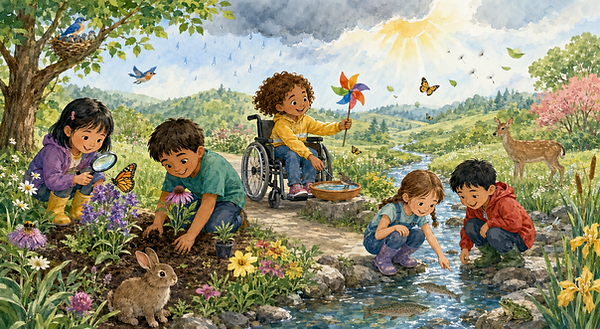
Listen to This Page
The written text on this page serves as the full and official version of this content
Earth’s air, water, soil, weather, plants, animals, and people are all connected. They work together like members of one very large team.
Rain helps plants grow. Plants provide food and shelter for animals. Healthy soil holds water and gives plants nutrients. Trees help clean the air and provide shade. Animals can carry seeds to new places.
When one part changes, other parts may feel the difference too.
Weather and Climate
Weather tells us what the air is like today. It may be sunny, rainy, windy, hot, or cold.
Climate is the usual pattern of weather in a place over many years. A desert, forest, mountain, and coastline each have different climate patterns.
Earth’s climate has always changed slowly. Today, burning large amounts of coal, oil, and natural gas is warming Earth more quickly. This can change rainfall, seasons, oceans, ice, and some storms.
Air Travels
Air is always moving. It carries:
-
oxygen that people and animals breathe
-
carbon dioxide that plants use
-
water that can become clouds and rain
-
pollen and seeds
-
dust and smoke
Because air travels, clean air is important everywhere. Caring for the air can also help people, animals, plants, soil, and water.
Nature Helps Earth Stay Healthy
Forests, grasslands, oceans, wetlands, rivers, and healthy soil do many important jobs. They provide homes for living things, hold water, protect soil, store carbon, and help keep air and water clean.
A wetland can soak up extra rain. Trees can cool a neighborhood. Healthy soil can hold water for plants during dry weather.
Learning About Earth
People use many tools to study our planet:
-
satellites watch clouds, storms, forests, oceans, smoke, and ice
-
air sensors check what is in the air
-
weather tools measure rain, wind, and temperature
-
cameras and sound recorders help scientists find animals
-
computers help people notice patterns
These tools can give communities more time to prepare for hot weather, storms, floods, drought, or wildfire.
Helping Earth’s Team
People can help by:
-
caring for trees and native plants
-
keeping water, air, and soil clean
-
creating safe places for wildlife
-
saving water and energy
-
reducing waste
-
walking, bicycling, or using cleaner transportation when possible
-
learning about the plants, animals, weather, and water nearby
Key Idea
Everything on Earth is connected. When we care for air, water, soil, plants, and animals, we help the whole living team including ourselves.
Grades 4–7
Earth’s Living Connections

Listen to This Page
The written text on this page serves as the full and official version of this content
Earth is made of many connected systems. Climate, air, water, soil, oceans, plants, animals, and ecosystems continually affect one another.
For example, rainfall affects soil moisture and plant growth. Plants influence air, soil, shade, and water movement. Those plants may provide food and habitat for insects, birds, and other animals. Animals spread seeds, pollinate flowers, and return nutrients to the soil.
A change in one part of this network can travel through many others.
Weather, Climate, and Seasons.
Weather describes short-term conditions such as today’s temperature, rain, wind, or humidity. Climate describes the usual weather patterns in a region over many years.
Climate influences:
-
how much water is available.
-
which plants can grow.
-
where animals find food and shelter.
-
when species migrate or reproduce.
-
the length of growing seasons.
-
wildfire and flood conditions.
-
conditions in oceans, forests, grasslands, and wetlands.
Earth’s climate has changed naturally throughout its long history. However, human activities especially burning coal, oil, and natural gas are now adding greenhouse gases to the atmosphere and warming the planet more quickly. This is changing temperatures, rainfall patterns, ice, oceans, seasons, and the intensity or frequency of some extreme events.
Different places experience these changes differently. One region may have greater drought, while another may receive heavier rainfall or face changing coastal conditions.
Air Connects Distant Places.
Air carries much more than oxygen. Moving air can transport:
-
water vapor.
-
carbon dioxide.
-
pollen and seeds.
-
dust and soil particles.
-
smoke from wildfires.
-
gases and pollution.
-
tiny living organisms.
Smoke or pollution can travel far from where it began. Air quality in one location may therefore be affected by activities or events hundreds or even thousands of miles away.
Clean air supports people, wildlife, plants, soil, and water. Protecting air quality is part of protecting the entire environment.
When Changes Combine
Environmental conditions do not occur separately. Heat can dry plants and soil, which may increase wildfire risk. Wildfire can remove vegetation, release smoke, and leave soil more likely to wash away during heavy rain.
That soil may then enter rivers and affect water quality and aquatic life.
Climate change can also combine with habitat loss, pollution, invasive species, or excessive water use. Understanding these connections helps people plan more effective solutions.
Nature Is Essential Infrastructure
Healthy natural systems perform work that communities depend upon:
-
forests store carbon, protect soil, provide shade, and help guide water.
-
wetlands absorb water, filter pollutants, and provide wildlife habitat.
-
grasslands hold soil and support diverse species.
-
oceans move heat, store carbon, and support enormous food webs.
-
healthy soil stores water, nutrients, and carbon.
-
diverse ecosystems are often better able to adjust to changing conditions.
Technology can help, but it cannot fully replace these living systems.
New Ways to Observe Earth.
Scientists and communities now have powerful tools for understanding environmental conditions:
-
satellites track storms, drought, vegetation, snow, ice, oceans, wildfire, and smoke.
-
local sensors measure air pollution and weather conditions.
-
ocean floats measure temperature, salt levels, oxygen, and currents.
-
wildlife cameras record animals without disturbing them.
-
acoustic monitors identify birds, insects, frogs, and other species by sound.
-
environmental DNA can reveal which species have been present in water or soil.
-
drones help examine forests, farms, coastlines, and hard-to-reach places.
-
artificial intelligence helps researchers find patterns in very large collections of information.
Forecasting and early-warning systems may give communities more time to prepare for heat, wildfire, floods, storms, drought, and poor air quality.
Building a More Sustainable Future.
People are developing many ways to reduce environmental harm and prepare for changing conditions. These include:
-
cleaner energy and transportation.
-
pollution controls.
-
water conservation and reuse.
-
farming that uses water and nutrients more precisely.
-
buildings designed for heat, cold, smoke, and storms.
-
restoration of forests, wetlands, grasslands, waterways, and coastlines.
-
biochar that may help some soils hold carbon and water.
-
materials designed to use fewer resources.
-
systems that capture carbon from industries or directly from the air.
Some technologies are already widely used. Others are still being tested and may have costs, limitations, or unexpected effects. Careful research helps people decide which approaches are safe and useful.
How Young People Can Participate
Young people can:
-
learn about their local climate and ecosystem.
-
observe weather, plants, insects, birds, and seasonal changes.
-
help grow native or climate-appropriate plants.
-
protect water and soil.
-
reduce waste and unnecessary energy use.
-
take part in community science projects.
-
support safe habitats for pollinators and wildlife.
-
imagine new tools and solutions.
-
ask how a decision might affect other parts of Earth’s connected systems.
Key Idea.
Earth is not a collection of separate parts. Air, water, soil, climate, plants, animals, and people form a connected living network. Combining good science, thoughtful technology, responsible choices, and care for natural systems can help create a healthier and more resilient future.